
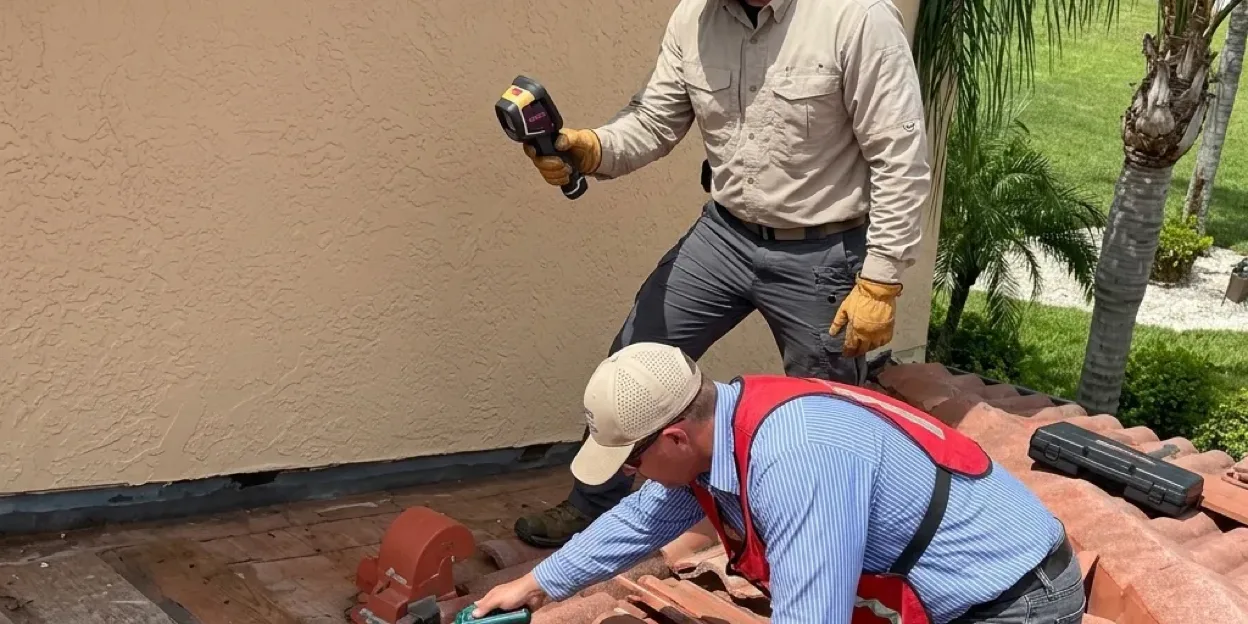
The buyer's inspector flagged the roof as "near end of life" on a house you are trying to close on in three weeks. Or the insurer wants a roof condition report before renewal. Either way, someone needs to walk the roof and write down what is there. This site connects you by phone with an independent local roofing contractor who inspects roofs in Lee County.
The contractor walks the roof surface and checks every slope, valley, penetration, and edge. Then the attic, where accessible: decking condition from below, signs of past leaks, how the deck is nailed, how the trusses tie to the walls, and whether there is a secondary water barrier. Some contractors bring a thermal camera to find wet decking that looks dry from above.
The result is a written report with photos. It says what the roof is, how old it appears, what is wrong now, what is likely to go wrong soon, and what the remaining useful life looks like. That last number is the one insurers and buyers care about.
Find out what the roof is and when it was last permitted. The county property appraiser's site lists building permits by parcel, and the roof year is often there. If an insurer asked for the inspection, find out which form they want. A 4-point inspection covers roof, electrical, plumbing, and HVAC on an older home. A wind-mitigation inspection uses a standard Florida form and records the roof's wind-resistant features. A general roof condition report is a third thing. Clear the attic hatch.
Insurers use it to decide whether to write or renew. Florida law says an insurer cannot refuse a policy solely because a roof is under fifteen years old, and for a roof past fifteen it must accept an inspection showing five or more years of useful life left. A report that finds a sound deck and intact underlayment can keep a policy in place without a replacement.
Buyers and sellers use it to settle a repair credit. Homeowners use it after a storm to create a dated record before a leak shows up, and before a wind-mitigation form to see whether a new roof would score better. When the report finds real problems, the next step is roof repair or, on a roof that is done, roof replacement.
The county's housing is split by Ian. Post-2022 roofs are new and worth documenting on a wind-mitigation form now, because many were installed to the current code and the credits go unclaimed. Pre-Ian roofs, especially 1990s and 2000s tile over felt underlayment, are the ones drawing insurer letters. An inspection tells you which side of the fifteen-year rule the roof is on and whether the underlayment has any life left.
Wind-mitigation features that score in Lee County include a hip roof shape, deck nailing at the current spacing, hurricane clips or straps at the roof-to-wall connection, and a sealed roof deck. The state's My Safe Florida Home program has funded wind-mitigation inspections and matching grants for qualifying single-family homes when it has been open for applications. A separate roofing contractor's inspection is still the one that tells you whether the roof is leaking.
Sanibel and Fort Myers Beach homes carry flood-zone rules that affect what can be rebuilt. An inspection there should note the roof's condition in enough detail to support whatever the town's building desk asks for later.
Have the address and say why you need the inspection: an insurer letter, a sale, a storm, or a wind-mitigation form. Say what kind of roof it is and roughly when it was last done. Say whether the attic is accessible. Call (239) 306-8745.
 Standing by
Describe what you see in plain words. The call goes to an independent local roofing contractor who works your part of Lee County and decides what to look at first.
Barrel tile, architectural shingle, standing-seam metal, and low-slope membrane compared for Southwest Florida sun, salt, and wind.
What to photograph, what a contractor's written scope gives the adjuster, and the Florida deadlines that apply.
A leak, lifted shingles, or cracked tiles traced to the source and fixed before the next rain band reaches Lee County.