
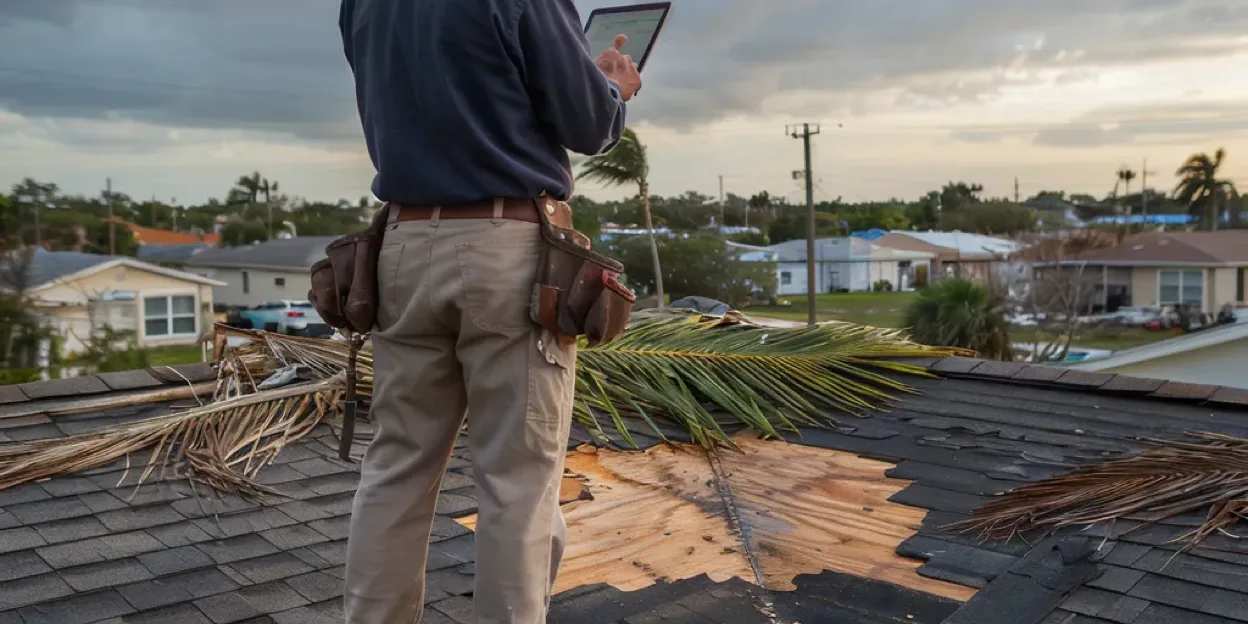
The wind stopped an hour ago. There are tiles in the pool, a strip of shingle in the neighbor's yard, and daylight showing at one corner of the lanai roof. Rain is forecast again tonight. This site connects you by phone with an independent local roofing contractor who handles storm damage in Lee County.
The first job is to stop water from getting in. That means a tarp or a temporary dry-in over the open area, fastened so the next band of wind does not take it. Before the tarp goes on, the crew photographs the damage from the roof and, where possible, from the attic. Those photos are the record of what the storm did.
Then the contractor walks the whole roof, not just the obvious spot. Wind lifts shingles and reseals them crooked. It cracks tile without moving it. It loosens ridge caps and pulls at flashing. Damage you cannot see from the ground shows up as leaks months later, so the walk covers every slope and the scope lists everything found.
Stay off the roof and away from downed lines. Photograph what you can see safely from the ground, from windows, and from the attic hatch. Photograph the inside too: stains, drips, wet insulation. Do this before anything is covered or moved.
Keep receipts for anything you buy to protect the house. Do not sign a contract on the doorstep. After Ian, out-of-town operators worked every street in the county, and some took deposits and left. Look up any contractor's license before you sign, and do not sign a document that assigns your insurance benefits to anyone.
Localized damage, a slope of lifted shingles, a dozen cracked tiles, a torn section of lanai membrane, is repaired. The contractor matches material where it can and replaces underlayment beneath the disturbed area. That is roof repair with a storm cause.
Widespread loss, meaning shingle stripped across multiple slopes, tile displaced over large areas, or decking soaked through, is a roof replacement. On a roof that was already old, an insurer often reaches the same conclusion. Either way, the contractor's photos and written scope are what the adjuster works from.
Ian made landfall at Cayo Costa on September 28, 2022, with 150 mph winds and pushed a surge of ten to fifteen feet across Fort Myers Beach and Sanibel. The wind field was wide enough that Lehigh Acres and Alva lost roofing too. Milton in October 2024 came ashore in Sarasota County, but its outer bands spun up tornadoes across the state, and one of them tore through Fort Myers the afternoon before landfall. Irma in 2017 and Charley in 2004 hit the same roofs a generation earlier.
Every summer afternoon brings smaller versions of the same thing. A wet-season squall with a sixty mile-per-hour gust front lifts shingle edges and drops branches on lanai roofs. The county's hurricane season runs June 1 through November 30, and the Florida Division of Emergency Management posts storm tracks, evacuation orders, and post-storm guidance statewide.
Florida policies require the homeowner to take reasonable steps to prevent further damage. A tarp is exactly that. Delay is what hurts: water spreading through decking and drywall for weeks turns a wind claim into an argument about neglect. Tarp first, then see the insurance claims page for what comes next.
Have the address and say whether water is coming in now. Say what came off, tile, shingle, metal panels, or a lanai roof, and roughly how much. Say whether you can see daylight from inside, and whether you have already photographed the damage. Call (239) 306-8745.
 Standing by
Describe what you see in plain words. The call goes to an independent local roofing contractor who works your part of Lee County and decides what to look at first.
A walk of the roof and attic with written findings for a sale, an insurer, or a roof that is past year fifteen.
Barrel tile, architectural shingle, standing-seam metal, and low-slope membrane compared for Southwest Florida sun, salt, and wind.
What to photograph, what a contractor's written scope gives the adjuster, and the Florida deadlines that apply.